7 min read
When a vehicle stops where it should not, the priority is no longer the car. It is the people. Over the years recovering vehicles right across Northern Ireland, we have seen how a calm, sensible response keeps drivers safe while they wait. This guide pulls together the advice that matters most, whether you are on a motorway, a quiet country road or driving home in the dark.
If you break down on a motorway
A motorway is the most dangerous place to stop, so a clear plan matters. If you can, move onto the hard shoulder, as far to the left as possible, and turn your wheels towards the verge. Put your hazard lights on at once. Then get everyone out of the vehicle by the left hand doors, away from traffic, and stand behind the safety barrier. Do not stay in the car, and never try to retrieve anything from the carriageway side.
- Pull as far left onto the hard shoulder as you safely can
- Hazard lights on immediately so others see you early
- Leave by the doors away from traffic and get behind the barrier
- Keep pets in the car, and keep yourself well back from moving vehicles
If you break down on a country road
Northern Ireland has miles of narrow, winding rural roads, and they bring their own risks. Visibility is often poor around bends and over crests, so other drivers may not see a stopped car until the last moment. Get the vehicle as far off the road as the verge allows, hazard lights on, and if it is safe, place a warning triangle well back up the road to give approaching traffic time to react. On a blind bend, stand somewhere you can be seen but not somewhere you could be struck.
Staying safe at night
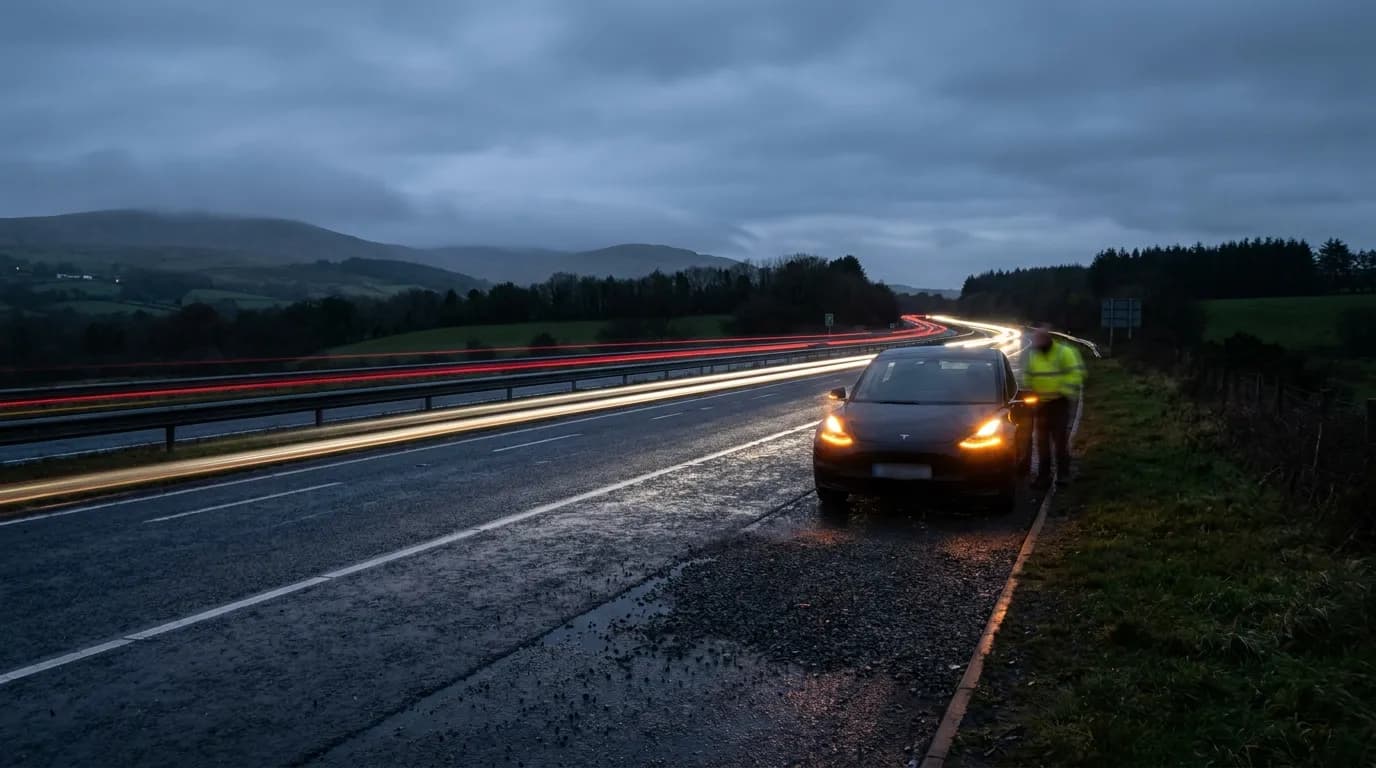
Breaking down in the dark adds an extra layer of risk, because you are far harder to see. Keep your sidelights or hazard lights on so you stand out. A hi vis vest kept in the car, rather than the boot, means you can put it on before you step out. Have a torch to hand and keep your phone charged. If you feel at all unsafe where you have stopped, especially late at night, stay aware of your surroundings and trust your instincts.
Personal security while you wait
Most people you meet are decent, but it pays to be sensible. If you are on a quiet stretch and you feel uneasy in the open, and you are not on a motorway hard shoulder, it can be safer to lock yourself in the car with a window slightly open to talk. On a motorway the opposite is true, where standing behind the barrier is always safer than sitting in the vehicle. Use your judgement based on where you are, and let us know on the call if you feel vulnerable so we can keep that in mind.
Calling for help the right way
When you call, the more you can tell us, the faster we can find you. Look for a marker post on a motorway, a road number, a nearby junction or a well known landmark. If you have a smartphone, your map app can usually give a precise location to read out. Stay on the line if you need to, and keep your phone with you. A clear, calm call gets a recovery truck to you sooner than anything else.
- Note your location: marker post, road number, junction or landmark
- Use a map app for an exact position if you can
- Keep your phone charged and on you, not left in the car
- Tell us if anyone is vulnerable or if you feel unsafe where you are